Your text classifier is 85% accurate. That error doesn’t vanish when you run the regression.
There’s a very specific high that hits when a classifier you’ve been wrestling with for days finally clears 85% on the held out set. It works. You run it over all fifty thousand comments, attach the predicted labels to your dataset, and move on to the analysis you actually cared about.
That’s the exact moment I want to grab your arm.
Because the 15% it got wrong doesn’t politely stay inside the classifier. It rides along into the regression, and it changes your answer. “Accuracy” is hiding how much.
A predicted label is a guess you’re treating as a fact
That’s the whole problem in one sentence. You didn’t observe “this feedback is specific.” You estimated it, with a model that’s right most of the time and wrong some of the time. The minute you drop those predictions into a regression as if they were the real thing, you’ve imported the model’s mistakes without telling the regression they’re there.
And the phrase “ground truth” makes it so much worse, because it’s not ground truth. It’s the classifier’s training target. In your actual analysis those labels are a noisy stand in, and calling them truth is how the error sneaks past you.
What the error does depends on what kind it is
If the mistakes are just random (the classifier is equally clumsy everywhere), and the noisy variable is a predictor, the effect gets attenuated. Pulled toward zero. This is the part people get wrong in conversation, by the way. “It’s just noise, it averages out.” A regression coefficient on a mismeasured predictor does not average out. It shrinks.
Differential error is the one that actually scares me. If the classifier is worse for some cases than others, in a way that’s tied to your outcome or your groups, the bias picks up a direction. You’re not just underestimating anymore. You can end up pointing the wrong way.
Your setup is the textbook case: you predict “feedback specificity” from teacher comments, then relate it to student progress. Now suppose the model reads feedback from teachers of multilingual learners a little worse. That error is now braided into exactly the comparison you care about, and it doesn’t wash out. It bends the conclusion.
Watch it happen
Six thousand simulated comments. The true effect of the text feature on the outcome is 1.0. I feed two classifiers’ predicted labels into the same regression and treat them as truth:
# True effect of Z on Y is 1.0 (simulated).
coef(lm(Y ~ Z))["Z"]         # if we had the true labels
coef(lm(Y ~ Zhat_nd))        # 85% accurate, error unrelated to anything
coef(lm(Y ~ Zhat_d)) # 85% accurate overall, but worse for one group| Labels used | Estimated effect |
|---|---|
| True labels | 1.00 |
| Predicted — nondifferential error | 0.68 |
| Predicted — differential error | 0.72 |
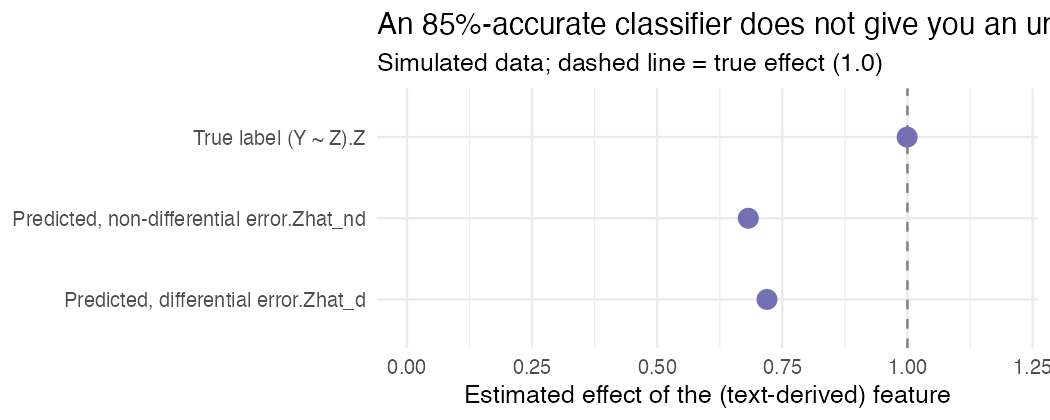
Sit with two things here. First: clean, random, 85%-accurate error drags a true effect of 1.0 down to 0.68. A third of your signal, gone, purely from treating guesses as data. Second, and this is the one that gets me: both classifiers report the same 85%. But the “differential” one is 93% accurate for one group and 78% for the other. The headline number cannot tell you which world you’re in. Only breaking accuracy out by subgroup can.
What to actually do
Keep a human labeled gold set, and not just for tuning. You need it to measure the error so you can correct for it later. Report classifier performance broken out by the groups you’ll compare, because “85% overall” is precisely where differential error hides. And then either propagate that uncertainty into the analysis or use an estimator built for predicted labels (there’s a small but real literature on inference with machine predicted variables now). Whatever you do, stop quietly swapping predictions in for observations and calling it done.
Measure your measurement. Report it by group. Let the error into the model the same way it’s already, invisibly, in your data.
This exact corner, where text models meet measurement error, is what I work on. I build baselinr and I’m putting together a cohort course on credible evaluation and measurement in education. subscribe via RSS if you want to follow along.