More controls ≠ less bias: the variables you should never put in your model
Okay so. Reviewers often ask for one more control. You add the variable, the coefficient changes, and it is tempting to take the change as proof the variable mattered.
It is not proof the variable mattered. It took me way longer than I’d like to admit to get that.
Adding a control and watching the number jump feels productive. It feels careful. But a number moving only tells you a number moved. It doesn’t tell you whether you got closer to the truth or further from it. That depends on what the variable actually is, and “just throw in more controls” quietly lumps together three things that behave nothing alike.
Three reasons a variable is in your model
One: it’s a confounder. Something that causes both who got treated and the outcome. Pretest scores, if the higher scoring kids were also more likely to get the program. You want these in the model. Leaving them out is the thing everyone’s (rightly) scared of.
Two: it’s a mediator. Something the treatment causes, which then moves the outcome. It’s part of how the program works. Control for it and you’re literally subtracting off a piece of the effect you came to measure.
Three: it’s a collider. The weird one. It’s a shared consequence of two things, and it sits there harmlessly until you condition on it, at which point it invents a correlation that was never real.
“Control for everything you can” treats all three the same. Two of them make your answer worse.
Just draw the arrows
This is less philosophical than it sounds. Sketch what causes what (a DAG, if we’re being formal). Then the rule is basically mechanical: block the paths that sneak in through the treatment, and leave alone anything the treatment causes or anything two variables jointly cause.
A reviewer saying “control for X” is making a guess about where X lives on that picture. It’s not a command. Go look at where it actually sits.
The one that got me
Say you’re evaluating a tutoring program and your outcome is test scores. Being responsible, you decide to control for student motivation. Reasonable, except you measured motivation after the program ran. Which means the program probably moved it. So now motivation is downstream of the treatment, and controlling for it shaves off exactly the part of the effect that went “kids got more into it, then did better.” You conclude tutoring barely did anything.
It did something. You just deleted the evidence. And it felt like diligence the whole time, because, again, the coefficient moved.
Watch it happen
I simulated this so it’s not just me asserting things. True total effect of the program: 8.5. There’s a trait C that drives both treatment and the outcome (a real confounder), and M is motivation measured after the program (a mediator).
# Estimand: total effect of `treat` on `Y` (simulated; true value = 8.5)
coef(lm(Y ~ treat))["treat"]          # naive
coef(lm(Y ~ treat + C))["treat"]      # adjust for the confounder
coef(lm(Y ~ treat + C + M))["treat"] # also adjust for the post treatment mediator| Model | Estimate |
|---|---|
Naive (Y ~ treat) |
11.46 |
+ confounder (Y ~ treat + C) |
8.61 |
+ mediator too (Y ~ treat + C + M) |
3.99 |
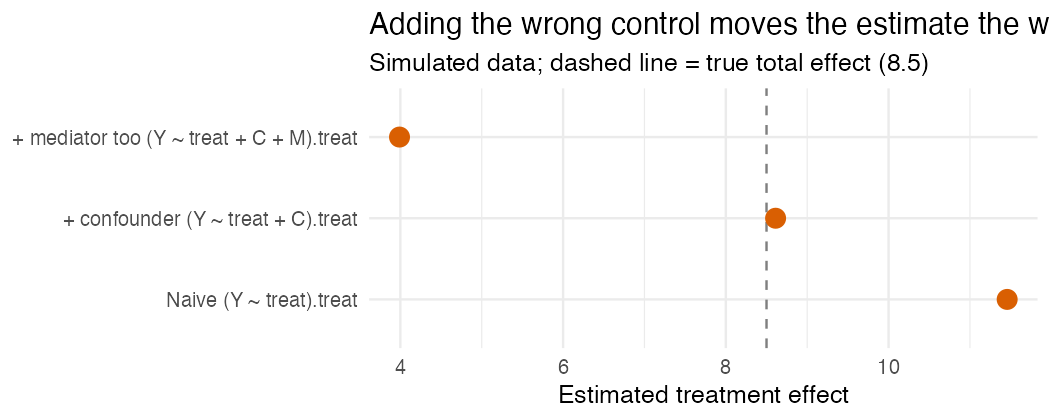
The naive number is too big because treated kids started ahead. Adjust for the confounder and it snaps to 8.61, basically the truth. Then you add the after the fact mediator and it falls to 3.99, because you just controlled away the thing the program works through. The model with the most controls is the most wrong. That’s the whole point.
What I actually do now
- Sketch the DAG before I touch the model. A bad drawing on a receipt counts.
- Only control for things measured before treatment.
- If a variable was measured after the treatment, I treat it as off limits until the picture tells me otherwise.
- For every control, I make myself say which of the three it is. If I can’t, it doesn’t go in.
I’m not against controls. I’m anti “more controls = more rigor,” because that one’s just false, and it’s the kind of false that looks like care.
I’m building baselinr, a small R package for WWC-aligned baseline equivalence, and a cohort course on running education evaluations you can actually trust. subscribe via RSS if that’s your thing.